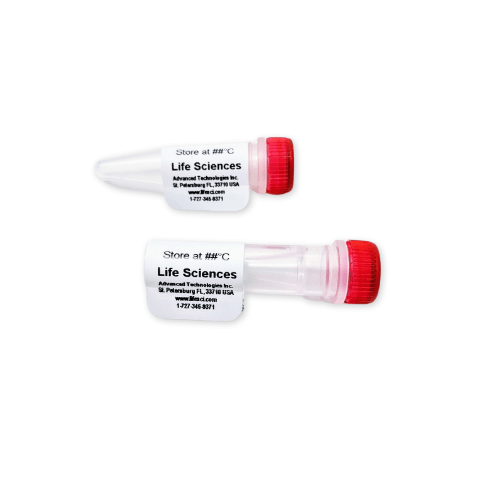
AMV Reverse Transcriptase

AMV Reverse Transcriptase

AMV Reverse Transcriptase (Standard Grade) synthesizes cDNA from single stranded RNA. The standard concentration is 20 units/µL and the specific activity is 40,000-50,000 units per mg. It is qualified for cDNA synthesis and RT-PCR.

Catalog No. Description Concentration Quantity Price
AMV007-S AMV Reverse Transcriptase 20.0 U/µL 300 U $60.00
Quantity :
AMV007-1 AMV Reverse Transcriptase 20.0 U/µL 1000 U $200.00
Quantity :
AMV007-5 AMV Reverse Transcriptase 20.0 U/µL 5000 U $850.00
Quantity :
AMV007-7 AMV Reverse Transcriptase 20.0 U/µL Bulk Please inquire
AMV007-7 is also available in custom concentration.


AMV Reverse Transcriptase XL

AMV RT-XL is a superior grade of native reverse transcriptase isolated from Avian Myeloblastosis Virus. This enzyme synthesizes cDNA from single-stranded RNA. Selected for very high specific activity, concentration and purity, each lot is function tested in cDNA synthesis to synthesize cDNA to an RNA ladder ranging in size from 0.5 to 9.0 Kb.

Catalog No. Description Concentration Quantity Price
RTHSA35 AMV Reverse Transcriptase XL 35.0 U/µL 500 U $147.00
Quantity :
RTHSA35-5 AMV Reverse Transcriptase XL 35.0 U/µL 5000 U $1200.00
Quantity :
RTHSA5 AMV Reverse Transcriptase XL 5.0 U/µL 500 U $147.00
Quantity :
RTHSA35-7 AMV Reverse Transcriptase XL 35.0 U/µL Bulk Please inquire
RTHSA6590 AMV Reverse Transcriptase XL 65-90k U/µL Bulk Please inquire
Applications 
For all AMV RT catalog numbers:
             cDNA Library production
             First strand cDNA synthesis for cloning
             RNA sequencing
             RT-PCR
             High-temperature cDNA Synthesis at up to 50ºC
Reagent supplied, with a protocol for cDNA synthesis:  
AMV Reverse Transcriptase 10X Reaction Buffer (Catalog # ARB 45)
At 1X concentration the magnesium ion concentration is only 5 mM. 
Under this condition, endogenous RNase H activity is not active. 

1X AMV RT Reaction buffer
25 mM TrisHCl, pH 8.3 @ 25ºC
50 mM KCl
2.0 mM DTT
5.0 mM MgCl2
Supplement with other components for cDNA synthesis

Unit Definition

One unit is defined as the amount of enzyme required to incorporate 1 nmol of dTTP into an acid-insoluble form in 10 minutes at 37ºC using poly(rA)-d(T)12-18 as template primer.

Unit Assay Conditions

0.5 mM [3H]-TTP, 0.4 mM rAn.d(T)12-18, 50 mM TrisHCl, pH 8.3, 40 mM KCl, 6.0 mM MgCl2, and 4.0 mM DTT. AMV RT preparations are diluted in a dilute phosphate buffer and added to the pre-incubated reaction to give linear kinetics.

Storage Conditions
0.2 M potassium phosphate, pH 7.2
2.0 mM Dithiothreitol
50% glycerol,
0.2% Triton X-100

Storage Temperature

-20ºC for 3 months or -70ºC for 1.5 years

Companion Products:

  1. For high temperature (up to 50ºC) cDNA synthesis to RNA with much tertiary structure, we offer a special 5X buffer containing dNTPs, BSA and a protocol requiring a higher RT input (#LSR 252).
  2. Primers p(dT)12-18 (LSR 233) and random hexamers (LSR 261), RNase-free water, and DTT solution are also available.
Catalog No. Description Concentration Quantity Price
LSR208 Dithiothreitol 250 mM 250 mM 30 µL $12.00
Quantity :
LSR219 RNase-Free H2O n/a 1.0 mL $5.00
Quantity :
LSR233 pd(T)12-18 Primer 0.5 µg/µL 0.5 µg/µL 35 µL $12.00
Quantity :
LSR252 5X Reaction Buffer n/a 50 µL $5.00
Quantity :
LSR261 Random Hexamer Primer 50 ng/µL 35 µL $7.00
Quantity :
LSR781 Rnase Inhibitor 12.5 units/µL 12.5 units/µL 25 µL $24.00
Quantity :

General Notes on the use of LSAT’s AMV RT:

  1. The optimal incubation temperature of a cDNA reaction using AMV RT is 42ºC. Use of the standard 10 X Reaction Buffer results in a final concentration of 5 mM MgCl2at 1X. At this concentration of MgCl2, the endogenous RNaseH of AMV RT is inactive.
  2. AMV RT is naturally more thermostable than other RT’s because of its origin from a chicken virus, whose host’s body temperature is 42ºC. However, it is usable at temperatures of up 50ºC, using LSAT’s High Temperature Buffer (Catalog # LSR 252).
  3. Recommended doses of AMV RT into cDNA reactions depends on the application, and the amount of primed RNA to be transcribed.

3.1 For one µg of polyadenlyated RNA, use 5 units of AMV RT in a 25 uL reaction.

3.2. For making a cDNA library, use 5 units of AMV RT per µg of RNA in a 25 uL reaction.

3.3. For RT-PCR, use the same guidelines in 1 and 2, then heat inactivate the RT for 5 minutes at 90ºC, then use an aliquot of the reaction for PCR.

Potency of LSAT AMV RT

It should be noted by the user that AMV Reverse Transcriptase from LSAT is very robust in the potency and purity of the product. It has been repeatedly documented that when compared in quantitative kinetic assays with AMV RT’s from well-known scientific houses, that the LSAT unit is at least five times more potent than that of others. This results in higher yields of cDNA and greater longevity of LSAT enzyme in your freezer.

Quality Control Testing:

All lots of AMV RT are stringently tested for exogenous Ribonuclease and Deoxyribonuclease, and are virtually nuclease free. For testing details and specifications, see below:

Deoxyribonuclease Activity:

50 units of AMV RT XL (or 30 units of AMV RT) are mixed with 0.5 µg of Hae fragments of Phi X174 DNA and incubated for 3 hours at 37ºC in a reaction buffer containing: 10 mM TrisHCl, pH 7.5, 5 mM MgCl2,and 1 mM CalCl2. No more than an equivalent of 0.05 unit per mL of DNase 1 is detected.

Ribonuclease Activity:

Twenty units of AMV RT XL (or fifteen units of AMV RT) was incubated with an one microgram of RNA ladder (0.5 – 9.0 Kb) in 1X ARB 45 buffer. Electrophoretic analysis of the RNA in an agarose gel indicated no greater than the equivalent of 8 X 10⁻⁸ units of RNase 1A. This assay is capable of detecting 2 X 10⁻⁸ unit of RNAse 1A.

cDNA synthesis:

In a 25 uL reaction without RNase inhibitor, one microgram of a poly-adenylated RNA ladder is primed with 0.5 ug of p(dT)12-18, then incubated with 1.0 mM dNTP’s in 1X ARB reaction buffer (Cat. # ARB 45) and 5 units of AMV RT XL at 42ºC for one hour. [32-P]-dATP is included in the reaction. The percent transcription is evaluated by TCA-precipitation, and an aliquot is alkalized and electrophoresed in an alkaline agarose gel.

The gel is then dried and exposed to X-Ray film to generate an electrophoregram. The dried gel is fractionated and the bands of cDNA evaluated by Cerenkov counting. The lot-specific data are stated of the Certificate of Analysis of each lot of RT-XL. At least fifty percent of the poly-A RNA is transcribed, with 55-80 percent of the cDNA being full-length.

References:

  1. Hellman, G.M., Shahabuddin, M., Shaw, J.G.., and Rhoads, R.E. (1983) Virology 128:210-220
  2. Houts, G. E.., Miyagi, M., Ellis, C., Beard, D., and Beard, J.W. (1979) J. Virol. 29:517-522
  3. McDonnell, M.S., Simon, M.N., and Studier, F.W. (1977) J. Mol. Bio. 110:119-146
  4. Locker, J. (1979) Anal. Biochem. 98:358-367
  5. Shimomaye, E., and Salvato, M. (1989) Gene. Anal. Tech. 6:25-28